
Limescale is wearing out your washing machine and dishwasher: the habit almost no one keeps

Washing machine heating element scaled with limescale in southern Luxembourg

Here is a figure that should change the way you run your washing machine. In hard water measuring 26.5 French degrees, the Swiss cantonal energy and environment services report that twice as much limescale forms at 65 C as at 55 C, and up to six times more at 75 C. In other words, the hotter the cycle you choose, the faster your appliances clog up on the inside. And in much of the south of Luxembourg, the water that feeds them is exactly the kind that scales up fastest.

Most households never see this damage because it happens out of sight, on the heating element. Yet a single, almost effortless habit can extend the life of your washing machine and dishwasher by years. This article explains, with official and scientific sources, what limescale really does inside your machines, why it costs you money on every cycle, and the simple routine that protects them. Whether you run a house in Esch-sur-Alzette or a flat in Dudelange, the principle is the same.

Why hard water in southern Luxembourg attacks your appliances

Water hardness simply measures how much dissolved calcium and magnesium your tap water carries. In Luxembourg it is expressed in French degrees (fH), and the official FAQ of the Water Management Administration reminds us that one French degree equals 0.56 German degrees. The Belgian consumer organisation ecoconso sets the usual benchmarks: water is considered soft from 0 to 15 fH, medium-hard from 15 to 30 fH, and hard above 30 fH.

So where does the south of the country sit? Toward the harder end. The accredited Luxembourg laboratory LLUCS reports that water in southern communes such as Esch-sur-Alzette, Differdange and Dudelange tends toward medium to high values, typically between 18 and 28 fH, and stresses that hardness varies strongly from one commune to the next depending on the local geology. That mineral load is harmless to drink, but it is precisely what turns into stone once your machines heat it up.

Limescale on the heating element: what really happens inside

The trouble starts with heat. When hard water is warmed past roughly 60 C, ecoconso explains, the dissolved minerals can no longer stay in solution and form an insoluble deposit, limescale, that settles on the heating elements of kettles, water heaters, washing machines and dishwashers. Inside your machine, that deposit builds up as a hard, chalky crust right where the water is heated.

And the higher the temperature, the worse it gets. This is exactly what the figure at the top of this article shows: in water at 26.5 fH, the Swiss cantonal energy and environment services found that twice as much scale forms at 65 C as at 55 C, and up to six times more at 75 C. They also note that a scaled element slows down heat transfer, so the appliance needs more time and energy to bring the water up to temperature, even if the precise amount is hard to quantify in any given home.

Luxembourg's own authorities reach the same conclusion. The Water Management Administration confirms that limescale present in very high quantities can impair the operation of household appliances. Left unchecked, the crust on the heating element does not just slow heating; over time it strains the part, and a failed heating element is one of the more common, and more expensive, reasons a washing machine or dishwasher ends its life early.

More limescale = more detergent and more electricity

Limescale hits you twice. The first cost is energy. A crusted heating element acts like an insulating blanket over the part that is meant to warm your water, so the machine works harder and longer; ecoconso notes that as a result energy consumption rises, sometimes very sharply. Every wash and every dishwasher cycle then quietly costs a little more than it should.

The second cost is on the shelf. Hard water also blunts your cleaning products: the same source explains that the effectiveness of laundry and cleaning products drops as hardness rises, so you have to use more of them to get the same result. That is why laundry sometimes feels stiff or grey, and why glasses come out of the dishwasher cloudy. You end up overdosing detergent to compensate, which raises your running costs again, without ever fixing the underlying problem.

The anti-limescale habit most households forget

The good news is that the fix is almost free and takes minutes. It comes down to one principle: stop making your machines run hotter than they need to, then clear the scale before it builds up.

Start with temperature. Because scaling accelerates so steeply with heat, the Luxembourg Water Management Administration and the Swiss energy services both recommend keeping your water heater between 55 and 60 C — hot enough for hygiene and comfort, but below the threshold where limescale forms most aggressively. On your washing machine, reserve very hot 90 C cycles for when you genuinely need them; most everyday laundry is perfectly clean at 30 to 40 C.

Then build a short routine around the machines themselves:

  • Run a hot, empty maintenance cycle with a suitable descaler in your washing machine and dishwasher roughly every one to two months.
  • Keep the dishwasher salt reservoir topped up: the built-in softener it feeds is your first line of defence against scale on the glasses and the element.
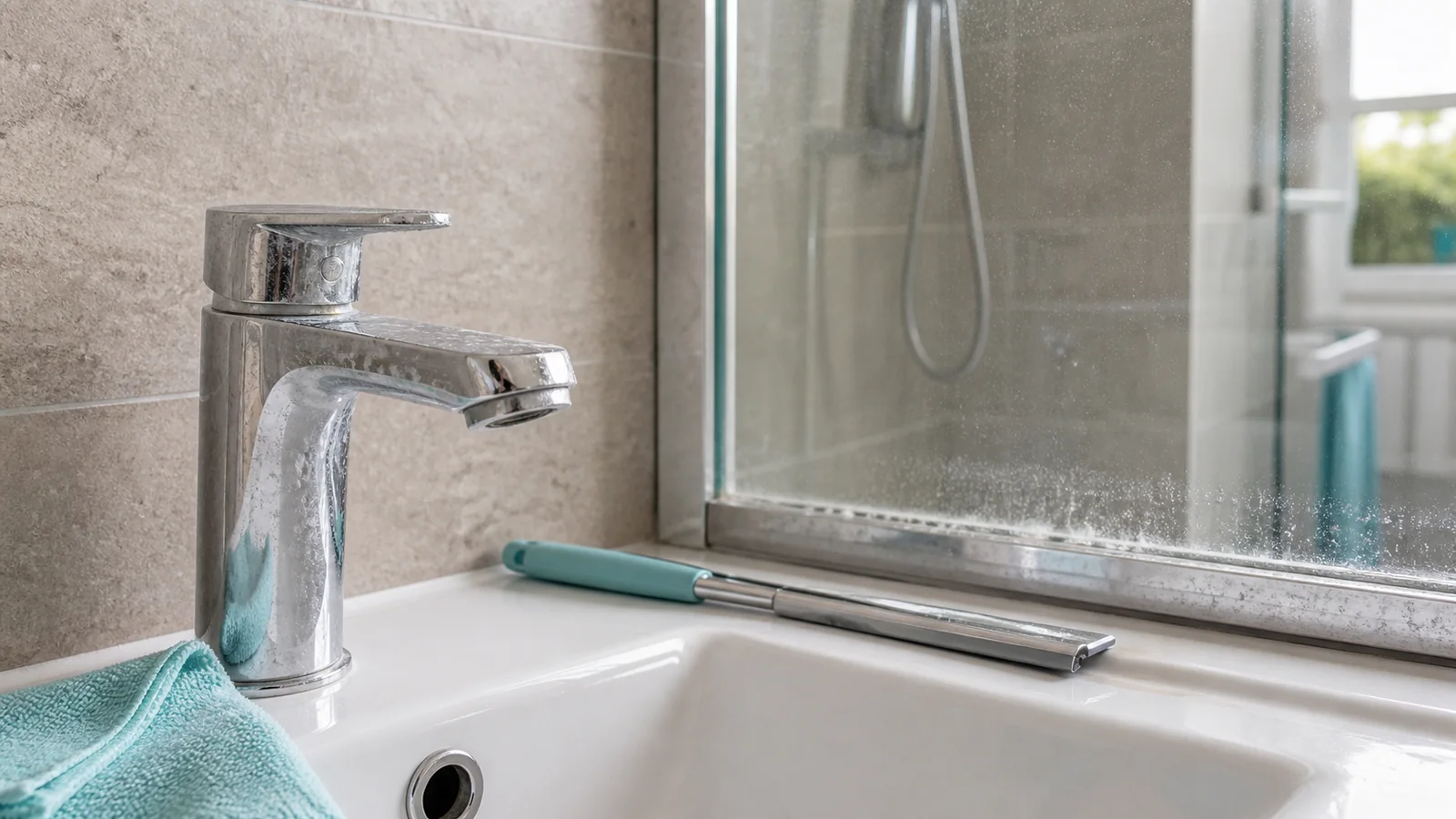
  • Wipe down taps, the shower head and the kettle regularly, so the white film never has time to harden.
  • Leave the washing machine door and detergent drawer ajar after a wash, so the drum dries and scale and residue do not bake on.

None of this is complicated. The reason it gets skipped is simply that limescale is invisible until something breaks — and by then the heating element is already paying the price.

Check the water hardness in Bettembourg, Esch or Dudelange

Before you set a descaling rhythm or even think about a softener, find out your actual figure, because it changes street by street, let alone commune by commune. The exact hardness depends on which source supplies your tap, and as LLUCS points out, southern Luxembourg's water is a blend of several supplies with real local variation.

Official, commune-by-commune data is published. The Water Management Administration states that hardness information is available through your municipality, and the figures it produces are also reused in open data: a reuse of the Administration's official tap-water hardness data covers 106 distribution zones across the whole country, including the south (Bettembourg, Esch-sur-Alzette, Dudelange and beyond). Look up your own value first; it tells you whether you need a light routine or a more serious approach.

On the question of softeners, the authorities are deliberately cautious. The Water Management Administration and ecoconso agree that a water softener should only be considered when hardness exceeds 30 fH (about 17 German degrees). Since most southern communes sit below that line, a sensible temperature setting plus regular descaling is usually all you need — no expensive equipment required.

Descale safely: what to do and what to avoid

For light, everyday descaling of a kettle, a shower head or visible scale on taps, white vinegar diluted in water does the job well: it is a weak acid that dissolves limescale, and we cover it in detail in our guide to natural cleaning products. Seal a scaled shower head in a bag of vinegar for an hour and the deposit lifts off easily afterwards.

There are a few firm rules, though:

  • Inside washing machines and dishwashers, prefer a product designed for the job. A dedicated appliance descaler is formulated for the seals, hoses and metal parts; reach for vinegar there only if your manufacturer's manual allows it, as repeated acid can damage rubber gaskets.
  • Never use vinegar or any acid on natural stone (marble, travertine, limestone). The acid attacks the stone and leaves dull marks that cannot be removed without professional re-polishing.
  • Never mix an acid with bleach. Combining the two releases a toxic, irritating gas. Keep your descaling and your disinfecting completely separate.
  • Always rinse thoroughly after descaling a kettle or coffee machine, and run a short empty rinse cycle after descaling an appliance.

Done little and often, descaling stays a five-minute job. Leave it for years and the scale becomes hard, thick and far harder to shift — sometimes impossible without replacing parts.

When a deep home clean makes the difference

Limescale is rarely a lone problem. Where the water is hard, scale tends to settle alongside soap residue, grease and grime on taps, shower screens, tiles and around the kitchen — the kind of build-up that ordinary weekly cleaning never quite removes. A periodic deep clean tackles all of it at once and resets your home to a clean baseline that is much easier to keep on top of.

That is where a professional team earns its place. For a thorough clean of your home, including the scaled-up corners of kitchens and bathrooms, discover our residential cleaning service for private households. We work across the south of Luxembourg, and we bring the equipment and method that turn an hours-long battle with limescale into a result you can actually maintain.

Tired of fighting limescale on your own?

Let Fast Clean take care of the deep clean. We work in private homes across the south of Luxembourg, from Bettembourg to Esch-sur-Alzette and Dudelange.

Book an Appointment

Sources

  • Water Management Administration (Administration de la gestion de l'eau), Luxembourg — Drinking water FAQ: eau.gouvernement.lu (accessed June 8, 2026).
  • data.public.lu — Reuse of official tap-water hardness data (qualite-eau.lu), 106 distribution zones: data.public.lu (accessed June 8, 2026).
  • LLUCS (ISO/IEC 17025 accredited laboratory) — Water hardness by commune in Luxembourg: llucs.lu (accessed June 8, 2026).
  • ecoconso — Water hardness (thresholds, scaling above 60 C, energy and detergent overconsumption, softener threshold): ecoconso.be (accessed June 8, 2026).
  • Swiss cantonal energy and environment services (energie-environnement.ch) — Limescale, water heaters and energy: energie-environnement.ch (accessed June 8, 2026).

Was this article useful? Share it!

Facebook LinkedIn WhatsApp