


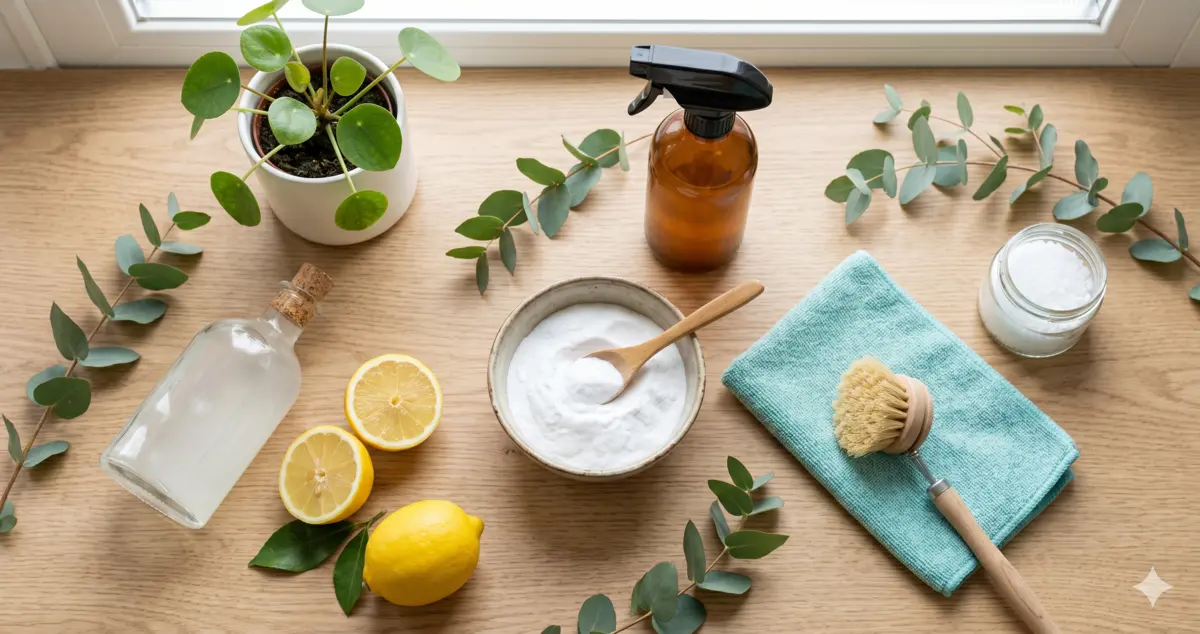
White vinegar, baking soda, black soap, lemon and washing soda can help with specific cleaning tasks. They are not universal or automatically harmless. The result depends on the product you bought, the amount you use, the surface and the method.
Start by reading the label, checking the care instructions for the surface or appliance and testing a small hidden area. This guide gives you a cautious way to choose. It does not replace the manufacturer's instructions or a registered product when genuine disinfection is required.
What to check before you clean
The word “natural” does not tell you whether a product is suitable for a worktop, grout, a wooden floor or a metal fitting. An acid can attack a mineral surface, a powder can dull a glossy finish and an over-concentrated cleaner can leave a film or irritate the skin. The useful question is not simply “is it natural?”, but “is it compatible with this surface and this task?”.
Keep each product in its original container, follow the stated dosage and ventilate while you work. If an appliance manual requires a particular cleaner or rules out vinegar, follow that instruction. Where the label permits it, apply a spray to the cloth rather than into the room. Our guide to ventilating your home properly gives you practical reminders.
Five products with different properties
White vinegar: useful for some limescale deposits
Vinegar is acidic. On a compatible surface, it can help remove a light mineral deposit. It should not be presented as a registered disinfectant: laboratory results obtained with acetic acid at a set concentration and contact time do not become general instructions for every bottle of household vinegar.
Do not use it on marble, travertine or other limestone. Check the manufacturer's instructions before using acid on taps, grout or an appliance; some manufacturers advise against it even when diluted.
Baking soda: gentle abrasive and deodoriser
Baking soda is a mildly abrasive powder. It can help lift some dirt or absorb an odour in an open container, but it can also dull or finely scratch a glossy surface. Test it in a hidden area first. Do not apply it to a textile or put it inside an appliance unless the care instructions allow it.
Baking soda fizzes when mixed with vinegar, but that reaction does not create a universal cleaner. It can also build pressure in a closed container, so never prepare or store this mixture in a sealed bottle.
Black soap: the versatile degreaser
Black soap varies in composition from one brand to another. Correctly dosed and rinsed, it may suit some washable surfaces. Too much can leave a film. Check the care instructions before using it on wood flooring, treated stone or a worktop finish.
Lemon: an acid, not a household antiseptic
Lemon juice contains citric acid. It can act on certain deposits, but it is not a registered disinfectant. Its acidity can mark natural stone, some metals, grout and delicate finishes. A fresh smell is not evidence that a surface has been disinfected.
Washing soda: for stubborn stains
Washing soda is not the same as baking soda. It is more alkaline and can be irritating. Follow the label for dosage, protective equipment and suitable surfaces. Keep it out of children's reach and do not mix it with another cleaning product.
Choose by task and surface
For a limescale deposit
Identify the material first. An acidic product may help on an acid-resistant surface if its care instructions allow it. For natural stone, delicate grout, a decorative finish or an appliance, use only the method specified by the manufacturer. Do not extend the contact time by guesswork, and rinse where the label tells you to.
For grease
Begin with a cleaner suited to the surface and the lowest stated dosage. Black soap may fit some situations; washing soda needs more care. For ovens, extractor hoods and other appliances, the manual should guide you so that coatings, aluminium and sensitive parts are not damaged.
For an odour
The source may be waste, persistent damp, a drain, a textile or an appliance. Remove the cause and ventilate instead of simply masking it. Baking soda can absorb some odours in a simple use, but it cannot repair a leak, remove mould or correct poor ventilation.
For floors, glass and worktops
There is no single recipe for every floor or pane of glass. Oiled wood, natural stone, laminate, screens and coated glass all have different care requirements. Use a small amount, follow the instructions and test a hidden area. For food-contact surfaces, also follow the rinsing directions on the label.
Mistakes and dangers to know
Do not combine cleaners in an attempt to make them stronger. A reaction may be invisible and still release a dangerous gas, cause splashes or damage the surface.
Never transfer a cleaner into a food or drinks container, and do not remove its label. Do not mix bleach with ammonia, either, or combine two products unless the label explicitly says that you may. Keep every cleaner away from children and pets.
A hidden-area test is especially important on natural stone, a lacquered finish, metal, grout or a textile. Wear the protective equipment required by the label. A food ingredient or a product marketed as natural can still harm skin, eyes and materials.
Summary table: use and precautions
| Product | Possible use | Check before use |
|---|---|---|
| White vinegar | Some limescale deposits | Acid-resistant surface; never with bleach |
| Baking soda | Some dirt and odours | Fine-scratch risk; hidden-area test |
| Black soap | Upkeep of washable surfaces | Dosage, rinsing and surface finish |
| Lemon | Some deposits on compatible surfaces | Acidic; not a registered disinfectant |
| Washing soda | Some stubborn grease | Label, protection and surface compatibility |
When to ask for the right advice
An old stain, an unknown material, natural stone, a textile or an appliance needs more care than an ordinary washable surface. Check the label and the manufacturer's instructions. If you are unsure, stop before spreading the product and ask a specialist who understands the material.
For ordinary home upkeep, you can describe your needs through our residential cleaning page. If you are moving out, see our end-of-tenancy cleaning information. Tasks, methods and any products are defined for the actual home and stated in the quote; this article does not describe a product or method that Fast Clean uses systematically.
Need Help with Ordinary Home Cleaning?
Describe the home and the cleaning tasks you need to Fast Clean. The possible scope and suitable method are confirmed after the request has been reviewed.
Request a visit