


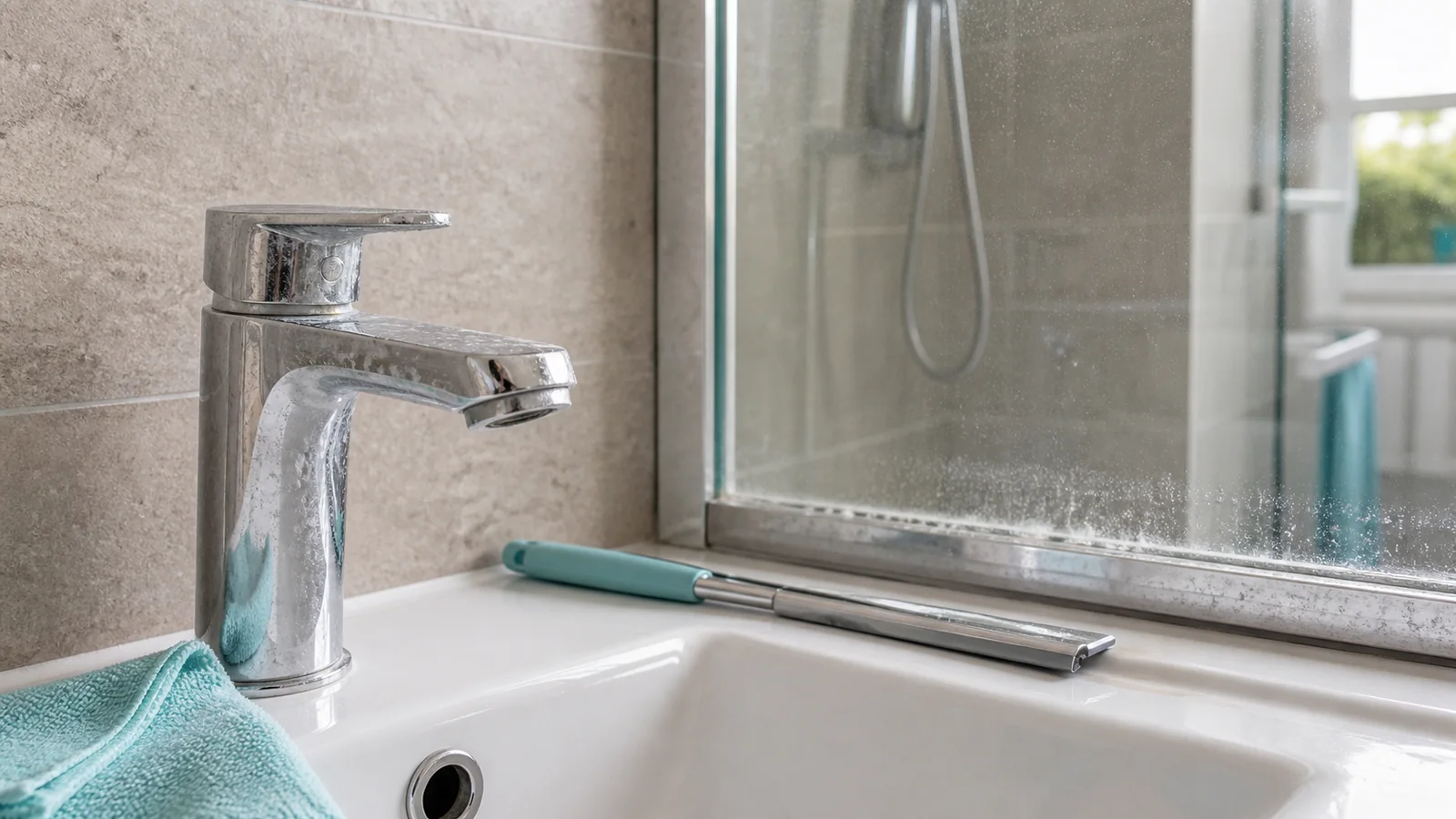
Do white marks quickly return on your taps or shower screen? They usually come from minerals that are naturally present in the water. In Luxembourg, hardness depends on the distribution zone and may change when water from several sources is blended. There is therefore no single figure for the whole south of the country: check the report for your address on Drenkwaasser.lu or ask your commune's water service.
Water hardness is not a drinking-water defect. Luxembourg's Water Management Authority states that limescale in water does not pose a health risk. Around the home, it mainly becomes visible when water dries or is heated and leaves mineral deposits on certain surfaces.
Check the water hardness for your address
A commune-wide average is not always enough. The Water Management Authority explains that one commune can contain several distribution zones. If water from different sources is blended, its hardness may also vary over the year. Before changing a product dose or buying water-treatment equipment, start with the value that actually applies to your home.
Recent results are published by the communes and can be accessed through Drenkwaasser.lu. The Water Management Authority's official “Dureté de l'eau” dataset also links water hardness to distribution zones on the Geoportal map. If your address is close to a zone boundary or the report is unclear, your commune's water service is the best source for confirmation.
What the value in °f and °dH means
In Luxembourg, water hardness is expressed in French degrees (°f) or German degrees (°dH). Under the Water Management Authority's classification, water is very soft from 0 to 9 °f, soft from 9 to 15 °f, moderately hard from 15 to 25 °f, hard from 25 to 35 °f and very hard above 35 °f. One French degree is equal to 0.56 German degrees.
This scale describes the amount of calcium and magnesium in the water. It does not measure how clean your home is, nor does it determine the sanitary quality of the water on its own. Its practical purpose is to explain why deposits appear at different rates and to help you follow dosing information on certain products and appliances.
Why white limescale marks keep returning
While the minerals remain dissolved in water, they are barely visible. When a drop dries on a shower screen, tap or around a sink, the water evaporates but some of the minerals stay behind. More thin layers can then build up with each use. Heat also encourages deposits where water is heated.
A recent mark and an old, firm deposit do not require the same effort. Starting with gentle, regular cleaning helps you avoid heavy scrubbing on a surface that may already be fragile. If a dull mark remains after cleaning, it may be damage to the material rather than limescale sitting on top of it.
Reduce deposits in day-to-day use
The simplest step is to remove water before it dries. Use a squeegee on the shower screen, then wipe taps with a clean, soft cloth. This short routine limits build-up without adding more cleaning products. Good bathroom ventilation also helps moisture leave the room, although it does not replace wiping away droplets.
Avoid abrasive tools on glass, glossy surfaces and metal finishes. Rinse away the cleaning product, then dry the surface. If you do not know what a vanity top, basin or shower tray is made from, identify the material before using a limescale remover.
Remove limescale without damaging the surface
The Water Management Authority mentions white vinegar diluted with water for routine care of sanitary fittings and some small appliances. This does not mean that every acidic product is safe on every surface. Identify the material first, then follow both the product label and the manufacturer's care instructions. Our guide to natural cleaning products explains the uses and limits of common household products.
Safety rule: never mix vinegar, citric acid or another acidic descaler with chlorine bleach or another cleaner. Anses warns that mixing bleach with an acid can release toxic chlorine gas. Use one product at a time and follow its dilution, contact-time and rinsing instructions.
Do not use vinegar, lemon or other acidic products on marble, travertine or limestone: they can dull or etch the stone. Choose a neutral cleaner that is explicitly suitable for the material. There is no universal rule for enamel, chrome or lacquered finishes and grout, so check the manufacturer's advice and test a new product on a discreet area first.
Appliances: follow the manufacturer's instructions
The Water Management Authority mentions diluted white vinegar for some small appliances. That general advice does not replace the manual: depending on the brand and model, vinegar or citric acid may be permitted, require a different dilution or be discouraged. For a kettle, coffee machine, washing machine or dishwasher, use the programme and product specified by the manufacturer.
Our guide to limescale and household appliances explains how to adapt dosing and care to local water hardness without turning advice for a water heater into instructions for every appliance. A fault, leak, unusual smell or job that requires dismantling belongs with the manufacturer, after-sales service or a qualified technician.
Need help with your home cleaning?
Fast Clean offers regular or one-off cleaning for houses and flats. The scope of the visit is agreed with you before the quote.
Request a visitSources
- Administration de la gestion de l'eau, drinking-water FAQ: classification, variation by distribution zone, drinking-water quality and routine care (accessed 10 August 2026).
- Administration de la gestion de l'eau / data.public.lu, “Dureté de l'eau” dataset, updated 11 July 2026 (accessed 10 August 2026).
- Anses, warning not to mix bleach and vinegar (accessed 10 August 2026).
- Natural Stone Institute, natural-stone care and sensitivity to acids (accessed 10 August 2026).
- Bosch, an example of manufacturer guidance advising against vinegar and citric acid for the relevant appliance (accessed 10 August 2026).