


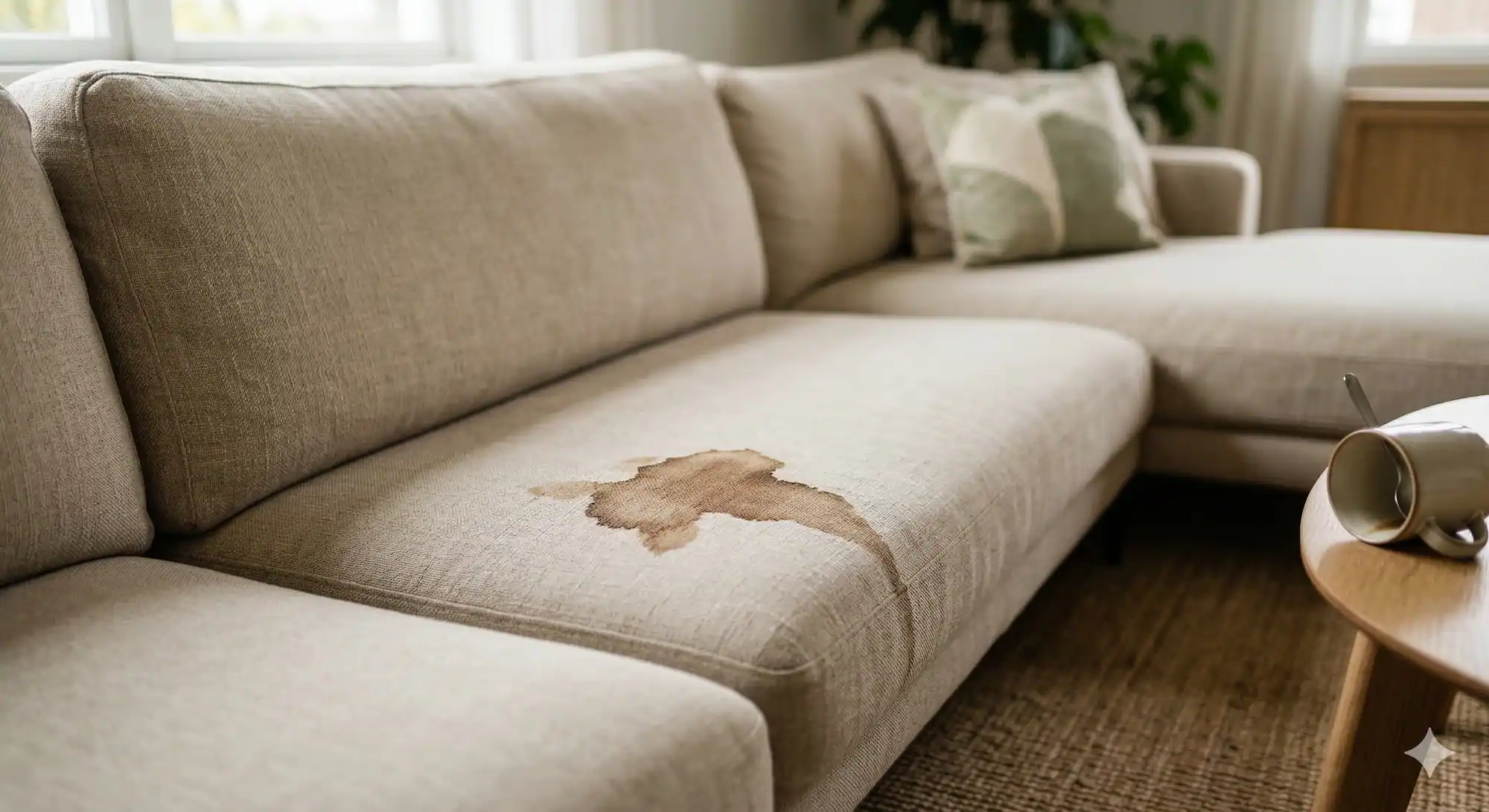
Here is a number that explains why red wine is the nightmare of every light-coloured sofa: a full-bodied young red can carry around 500 milligrams of anthocyanins per litre, and in some wines more than 2,000, according to a peer-reviewed paper in the journal Molecules, which describes these water-soluble flavonoid pigments as the principal source of red colour in wine. In other words, a single tipped glass releases a concentrated dye straight into your upholstery. The good news: if you act fast and the right way, you can win this. The bad news: the most common reflex, reaching for hot water, is exactly what locks the stain in.
This matters all the more here in the south. From the slopes above Remich down to the spa town of Mondorf-les-Bains, the Luxembourg Moselle is red-wine country, and a relaxed evening with a Pinot noir is part of the local way of life. So is the spill that follows. Whether it lands on a fabric sofa, a leather armchair or a wool rug, this guide explains the chemistry first, then the moves that genuinely work.
A glass tipped over Moselle wine country: why red wine stains so badly
The Luxembourg Moselle is best known abroad for its white wines, but red wine is very much part of the picture. The official AOP specification for the Moselle Luxembourgeoise lists four red grape varieties, Pinot noir, Pinot noir precoce, St. Laurent and Gamay, and the deep, gypsum-and-Keuper-marl soils of the canton of Remich give rounded, softer reds. From Remich on the riverbank to Mondorf-les-Bains a few kilometres inland, a knocked-over glass of red is never far away.
And a glass that goes over is a small disaster, because red wine is essentially a natural dye in suspension. It pairs deep pigment with a sticky, acidic liquid that wicks straight into porous fibres. The colour you see soaking into the cushion is not just sitting on top, it is bonding with the material from the first seconds. That is why a spill is a race against time, and why understanding what is actually staining the fabric tells you exactly how to fight it.
Tannins and anthocyanins: what really happens in the fibres
Two families of compounds do the damage. The first is the anthocyanins, the pigments responsible for the red colour. The peer-reviewed review in Molecules is clear on this: anthocyanins are water-soluble flavonoid pigments, originating in the grape, and the principal source of red colour in wine. Because they are water-soluble, they spread readily through a damp fibre, which is both bad news (they travel fast) and good news (water is part of the cure when used correctly).
The second family is the tannins. The National Carpet Cleaning Association, the UK industry body, points out that the tannins in red wine are a natural substance found in grapes that dissolves more easily in cold water than in hot. That single fact decides your whole strategy: the temperature of the water you reach for changes whether the stain lifts out or sets for good. Anthocyanins and tannins both belong to the broad polyphenol group, and both bind more tightly the longer they are left to dry, so the clock starts the moment the glass tips.
The number one mistake: hot water that locks the stain in for good
The instinct is understandable: hot water cleans grease and grime, so surely it will help here too. With red wine it does the opposite. Heat helps fix the pigment into the fibre and, as the NCCA explains, the tannins themselves dissolve more easily in cold water than in hot. Pour boiling water on a fresh red-wine stain and you risk turning a removable mark into a permanent one.
The same logic rules out the tumble dryer and the hair dryer if any colour remains: applying heat to a stain you have not fully lifted bakes it in. The rule is simple and worth repeating to anyone who grabs the kettle: cold water only, no heat, until the colour is genuinely gone.
Four cold-water moves: blot, dilute, never rub
Speed is everything. As the NCCA puts it, the quicker you react to the stain, the more likely you are to remove it successfully. Here are the four moves that matter, in order.
- Blot, do not rub. Press a clean white cloth or paper towel straight down onto the stain to soak up as much wine as possible. Rubbing only drives the pigment deeper and spreads it sideways across the fibre.
- Work from the outside in. Always blot from the edge of the stain towards the centre, so you do not enlarge the marked area.
- Dilute with cold water. Dab the area with a little cold water on a fresh cloth, then blot again. Repeat, moving to a clean part of the cloth each time so you lift the colour out rather than spreading it back.
- Be patient and keep it cold. Several gentle cold passes beat one aggressive scrub. Let the spot air-dry and avoid any heat source until you are sure the colour has gone.
Done within the first minutes, this routine alone clears a surprising number of fresh spills, especially on a tightly woven fabric or a treated cushion cover.
Salt, soda water, vinegar: what works and what is a myth
Every household has its own legendary remedy. Some help a little, some do nothing, and a couple can make things worse.
Salt is the classic. On a fresh spill, especially on a carpet, a generous layer of salt can absorb part of the liquid still sitting on top, which buys you time before you blot properly. But salt does not break down the anthocyanin pigments, so it never fully removes the colour, and on some fibres a heavy salt residue is awkward to vacuum out. Treat it as first aid, not a cure.
Soda water is essentially cold water with bubbles. The cold is doing the useful work, in line with the cold-water principle above, while the fizz is largely a placebo. It will not harm anything, so use it if it is what you have to hand, but plain cold water does the same job.
White wine and vinegar are the two myths to be wary of. Pouring white wine onto a red stain does not neutralise it; you are simply adding more liquid. Vinegar is an acid, and on delicate or coloured upholstery and on natural fibres it can dull dyes or damage the material, so it is not a safe blanket solution for a good sofa. When in doubt, stay with cold-water blotting and call a professional rather than experimenting on an expensive cushion.
Fabric sofa, leather or carpet: matching the method to the material
The same spill calls for different handling depending on what it lands on.
On a fabric sofa, blot fast and dilute with cold water as above. Always test any cleaning product on a hidden seam first, because some upholstery dyes and some delicate weaves react badly. Avoid soaking the cushion through: too much water can leave a ring or reach the foam underneath.
On leather, the approach is the opposite of fabric: leather does not absorb the way a textile does, so the priority is to wipe the wine off the surface quickly with a soft, barely damp cloth before it seeps into seams or untreated patches. Never soak leather, never scrub it, and finish with a suitable leather conditioner once it is dry, the same care logic we cover in our guide to looking after a leather sofa.
On a carpet or rug, the salt trick can help on first contact, then you blot and dilute with cold water exactly as on fabric. Wool rugs in particular dislike heat and harsh chemicals, so cold and gentle is the rule, and a soaked-through rug is best handled with extraction equipment rather than left damp.
Dried or set in: when a specialist takes over
Home methods are made for the fresh spill caught in time. They reach their limit with a stain that has dried, an old mark discovered under a cushion, or wine that has soaked deep into the padding of a sofa or the pile of a wool rug. The longer the pigment sits, the more firmly it binds to the fibre, and at that point scrubbing harder usually means damaging the material rather than saving it.
This is where proper equipment changes everything. Spray-extraction injects a controlled cleaning solution and immediately vacuums it back out with the dissolved pigment, reaching depths a cloth cannot, without leaving the material waterlogged. Combined with agents chosen for the specific fabric and a method tested on a hidden area first, it lifts marks that look hopeless. For a set-in stain on a valuable sofa or rug, it is worth calling a specialist equipped for textile and upholstery work rather than risking the material with one more home remedy.
Keeping a tidy home around Remich and Mondorf?
Acting fast on a fresh spill is your best chance of saving the sofa. For a thorough clean of your home around Remich, Mondorf-les-Bains and the wider south of Luxembourg, see our residential cleaning service with Fast Clean.
Book an AppointmentSources
- National Carpet Cleaning Association (NCCA), Red Wine on Carpet: Stain Removal Guide - cold water vs hot, tannins as a natural grape substance, blotting and speed. Accessed June 8, 2026.
- He F. et al., Molecules (via PMC/NCBI), Anthocyanins and Their Variation in Red Wines - anthocyanins as water-soluble flavonoid pigments from the grape, principal source of red colour, typical concentrations. Accessed June 8, 2026.
- Appellation d'Origine Protegee Moselle Luxembourgeoise, official AOP site - Moselle wine region, canton of Remich, Keuper marls, red wine production. Accessed June 8, 2026.
- Ministere de l'Agriculture du Luxembourg, Cahier des charges AOP Moselle Luxembourgeoise (2020) - red grape varieties (Pinot noir, Pinot noir precoce, St. Laurent, Gamay) and geographic area. Accessed June 8, 2026.