


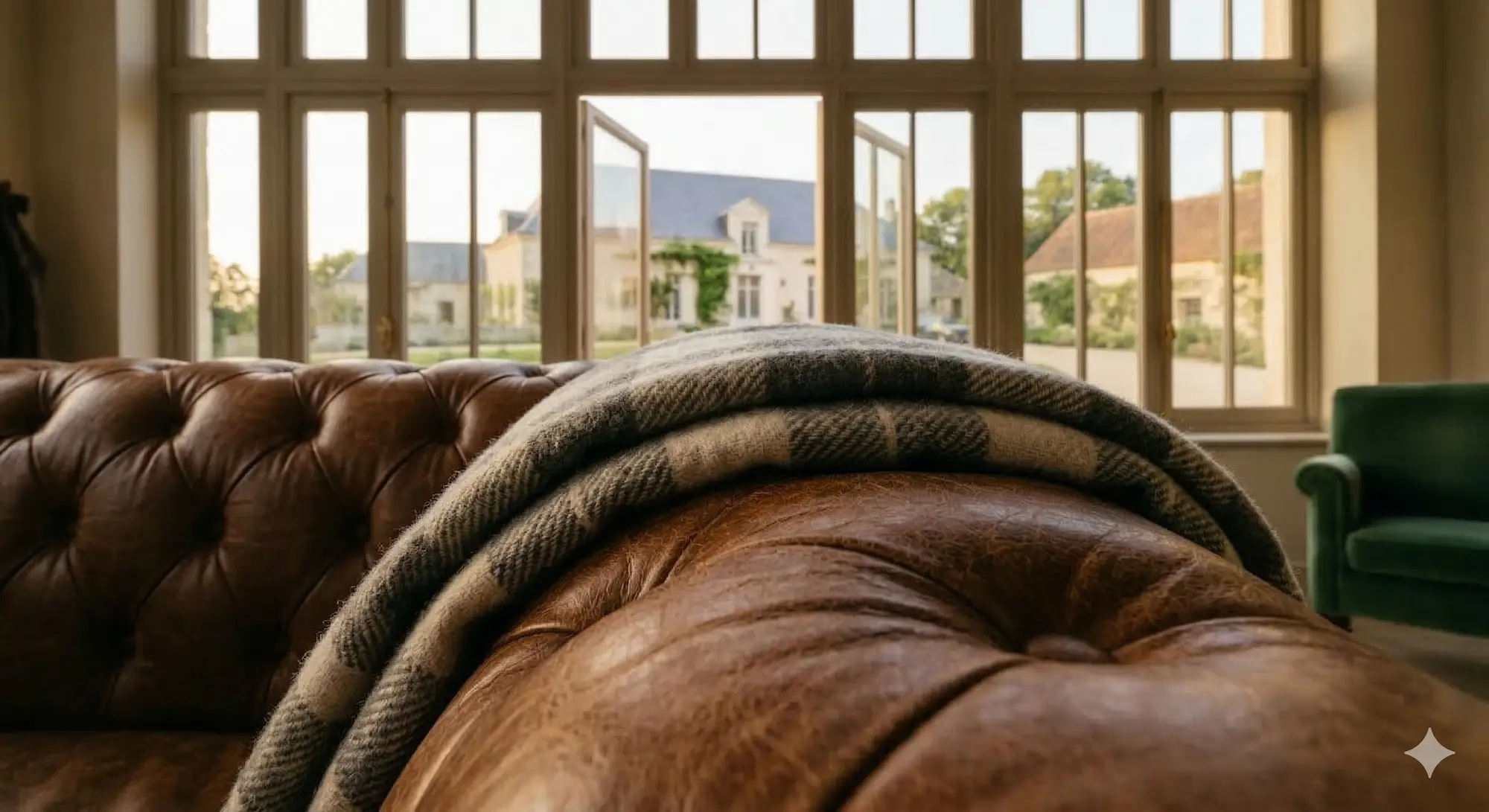
There is no universal care routine for a leather sofa. A product suited to pigmented leather may mark aniline leather, while a leather-look coating may require a different method. Start with the label, purchase information and the manufacturer’s care instructions.
This guide helps you decide what to check before you act. It does not replace the instructions for your sofa or an assessment by a leather-care specialist when the material is unknown or already damaged.
Start by identifying the material and finish
“Leather sofa” can describe very different surfaces: full-grain or corrected leather, aniline, semi-aniline or pigmented finishes, coated materials and imitation leather. You cannot always identify them reliably by appearance. Look for a model number, a label beneath the sofa or the documents supplied when it was purchased.
If you are unsure, do not apply a general “leather” product. An incompatible cleaner can mark a porous surface or change its colour, sheen or feel.
Aniline, semi-aniline and pigmented leather
Aniline leather retains a natural appearance and has little surface protection, so it is generally more sensitive to liquids and marks. Semi-aniline leather has a light protective finish. Pigmented leather has a more substantial coloured protective layer. These definitions are useful, but they do not identify a safe product without the sofa’s own instructions.
The Leather Working Group glossary explains these finish terms. Suede, nubuck, bonded leather and synthetic coverings each require their own care guidance.
Why the maker’s instructions come first
The manufacturer knows the material, finish and factory treatment. Its instructions should say whether dusting is enough, which cleaner or care product is allowed, and how it should be applied. Guidance can differ between models from the same brand. IKEA’s sofa and armchair guide distinguishes between leather types and tells owners of one listed model not to use care products at all.
The current page for Colourlock Leather Shield describes it for new pigmented and semi-aniline leather. It excludes porous leather, suede and nubuck. “During the first three years” refers to the age of the new leather for which the product is intended; it does not promise three years of protection from one application. Reapplication should follow the product instructions and the sofa’s actual use.
Cautious everyday care
- Remove dust gently with a clean, soft cloth if the sofa instructions allow it.
- Blot a fresh spill without rubbing, then check the maker’s guidance promptly.
- Where practical, avoid prolonged direct sunlight and strong sources of heat.
- Watch for repeated abrasion from buckles, rivets, clothing or pets’ claws.
- Do not layer several products in an attempt to correct the first result.
For a specific mark, identify the covering before following general stain advice. Our sofa stain guide explains that first step, while the article about red wine on a sofa shows why the first response must suit the material and finish.
Do not improvise with household products or steam
Vinegar is acidic, wipe formulations vary, and soap or detergent may be incompatible with the finish. Steam introduces both heat and moisture. This does not mean every brief contact will inevitably cause damage, but none of these is a safe default. Use a method only when the sofa manufacturer expressly permits it.
Labels such as “natural”, “gentle” or “for leather” do not prove that a product suits your model. A trial on a hidden area does not replace the instructions and should itself be done only in the way the manufacturer recommends.
A routine without fixed intervals
No weekly, monthly or six-month timetable suits every leather sofa. The finish, use, position and any approved product all matter. Observe the surface and follow the stated dosage, drying time and reapplication guidance instead of applying a product simply because a date has arrived.
Do not automatically add conditioner because the leather looks dull. A change in sheen can come from the original finish, wear or a product used previously. If the reason is unclear, stop before adding another layer.
Warning signs that mean you should stop
Ask for specialist advice before doing more if:
- you cannot identify the material or finish;
- the surface feels sticky, peels, flakes or has cracks;
- colour transfers to the cloth or a patch becomes lighter;
- ink or an old, extensive stain has penetrated the surface;
- a previous product changed the texture, sheen or colour.
Further experiments can obscure the problem or make later restoration harder. Take clear photographs and keep the names of products already used for the professional you consult.
When to ask a leather-care specialist
A specialist can identify the finish and assess whether cleaning, recolouring or restoration is realistic. The outcome depends on the material, its condition and previous treatments; it cannot be promised from a general guide or a photograph.
What Fast Clean does — and does not — provide
Fast Clean does not provide specialist leather cleaning, repair or restoration. Please contact a dedicated leather professional for that work. We can, however, provide general residential cleaning around the furniture within the agreed service.
See our residential cleaningSources
- Leather Working Group — essential leather industry terms
- Colourlock — current Leather Shield product page
- IKEA — sofa and armchair care guidance
- Canadian Conservation Institute — general guidance on light and heat
Sources accessed on August 10, 2026.