

Organising office cleaning: a simple method for a small business

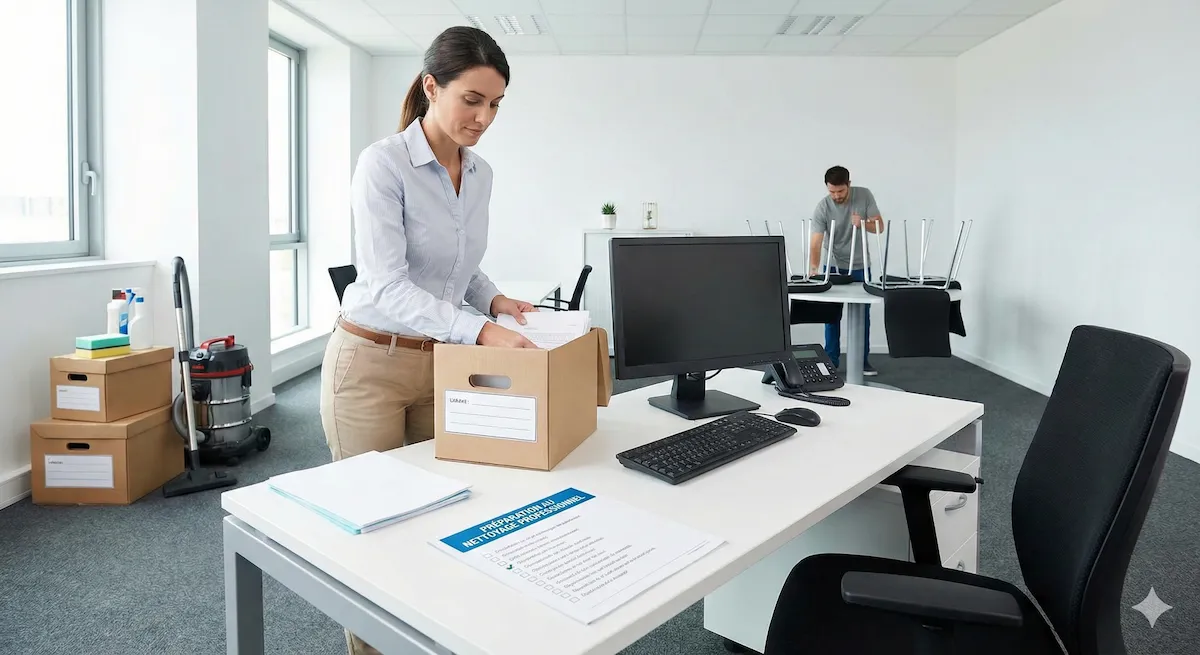
Clean, bright office space with tidy workstations

In a small business, office cleaning rarely makes it onto the weekly plan. It shows up on its own instead: a bin overflowing, a kitchen counter that feels sticky, toilets nobody volunteers to inspect any more. And it usually lands on the manager, squeezed in between two urgent tasks, because "it only takes five minutes" — except those five minutes come back every single evening. The good news is that organising office cleaning does not require software or a thick procedures manual. What it requires is answering three questions properly, once: what gets cleaned, how often, and by whom?

At Fast Clean, this way of structuring upkeep was born with private households: since 2012 we have been cleaning homes and flats across the south of Luxembourg, an environment that forgives very little. We have carried that standard over to small businesses — offices, shops, professional practices. Here is the method in five steps, which you can run through yourself whether your team cleans in-house or you hand part of it to a contractor.

Step 1: audit your needs, zone by zone

Before you talk frequency or contractors, walk through your premises with a notebook as if seeing them for the first time. The goal is to break the space into zones, because each zone has its own requirements:

  • Entrance and reception: the first impression you give a client or a job candidate. Floor, doormat, glass door, front desk.
  • Offices and open space: floors, dust on clear surfaces, waste bins.
  • Meeting room: table, screen, chairs — a room used rarely but highly visible whenever it is.
  • Toilets: the most sensitive zone, the one that makes or breaks the perceived cleanliness of everything else.
  • Kitchen corner or break room: sink, worktop, microwave, inside of the fridge, bin.
  • Circulation areas: corridors, staircase, lift if there is one, bin storage.

Then add the touchpoints to your map: door handles, light switches, stair rails, lift buttons, the coffee machine, the shared printer. These are the most-touched surfaces of the day and, paradoxically, the ones nobody cleans spontaneously — everyone assumes someone else is on it. Yet this is where the real hygiene of an office is decided, far more than on a shiny floor.

Step 2: decide who does what — keep or delegate

The second structural decision is the boundary between what your team keeps doing day to day and what you hand over. Some habits must stay internal, because no contractor can carry them for you: everyone keeps their own desk in order, coffee cups are washed straight away, the meeting room is reset after use. That is team culture, not cleaning.

Conversely, three criteria suggest a task is better delegated:

  • Regularity: the task has to happen even in busy weeks. Toilets do not wait for the end of the rush.
  • Technique: floors maintained according to their material, the right products, and a method that avoids carrying dirt from one zone to the next.
  • Stakes: whatever touches your image (reception, glazing) or hygiene (toilets, kitchen corner, touchpoints) deserves systematic treatment, not "when someone has a minute".

The classic small-business mistake: "everyone pitches in on Friday". The intention is good; in practice it rarely survives more than a few weeks — and it is always the same thankless zones that slip through.

Step 3: put the scope in writing, even one page

Whether you outsource or keep cleaning in-house, capture the result of the first two steps in writing. One page is enough: the list of zones, the tasks planned in each zone, their frequency, and what is deliberately excluded (high windows, for instance, or the inside of cupboards).

That document does three jobs. It prevents misunderstandings — the "were the windows included?" question disappears. It lets you compare contractors' offers on an identical basis instead of vague promises. And it becomes the reference for quality follow-up: you check what was agreed, not impressions. To get there faster, our online cleaning plan tool walks you through it zone by zone and produces a structured document you can share with a contractor as it is.

Step 4: set a frequency per zone, not one for everything

The natural reflex is to pick one global frequency — "a visit each week" — and squeeze everything into it. That is the surest way to overdo some zones and neglect others. Think per zone instead:

  • Every visit: toilets, touchpoints, bins, kitchen surfaces. This baseline is not negotiable.
  • According to footfall: floors and dusting. A shop with walk-in customers and a four-person office do not wear their floors at the same rate.
  • Periodically: interior windows, skirting boards, cupboard tops, inside of the fridge, descaling the machines. These tasks get scheduled — otherwise they never happen.

And plan to revisit the rhythm whenever the situation changes: a new hire, roadworks outside bringing in dust, or simply winter, when mud and pavement salt come in on people's shoes. A frequency that stays frozen for two years is a wrong frequency.

Step 5: track quality through a main contact

Follow-up is the step small businesses skip most often — then the standard slips quietly, nobody knows who to tell, and eventually everything gets called into question. The fix is simple and adds zero meetings to your diary:

  • One referent on each side. In your company, one person collects the team's remarks. At the contractor, a main contact receives them and answers — not a generic inbox.
  • One channel. Feedback goes through that pair, in writing when possible, rather than scattered comments in the corridor.
  • The written scope as the reference. You check, zone by zone, what the document says. If a new need appears, you update the document instead of stacking up verbal requests.

Run this way, cleaning becomes a settled subject: a short check-in now and then, and the manager never hears about the bins again.

The mistakes that waste your time

  • Keeping everything in-house on principle. The sensitive tasks — toilets, touchpoints — end up neglected, and the manager compensates in the evening.
  • Outsourcing without a written scope. With no shared reference, every disappointment turns into a debate over interpretation.
  • One frequency for everything. Critical zones are under-served, quiet zones over-served.
  • Cleaning during business hours. A vacuum cleaner in the middle of a client call bothers everyone; schedule visits outside working hours.
  • Judging by feel. Without a reference document, the mood of a rainy Monday stands in for quality control — and it is unfair in both directions.

What if you decide to outsource?

If your audit leads you to outsource, look for a contractor who accepts exactly this framework: a written scope from day one, a frequency per zone, a main contact for follow-up, and visits outside working hours so your team is never disturbed. That is precisely how we built our office cleaning service for small businesses in the south of Luxembourg: a standard that was born with private households, applied to business premises — because in the end, an office is judged with the same eyes as a home.

The most important part is still the first step: one walk through your premises, one written page, and the subject stops being a mental load. The rest is just consistency.

Ready to settle this once and for all?

Tell us about your premises and your priorities: we will build a written scope and a per-zone frequency with you, with a main contact for follow-up. Fast Clean works with small businesses across the south of Luxembourg, outside working hours.

Request a Quote

Was this article useful? Share it!

Facebook LinkedIn WhatsApp