


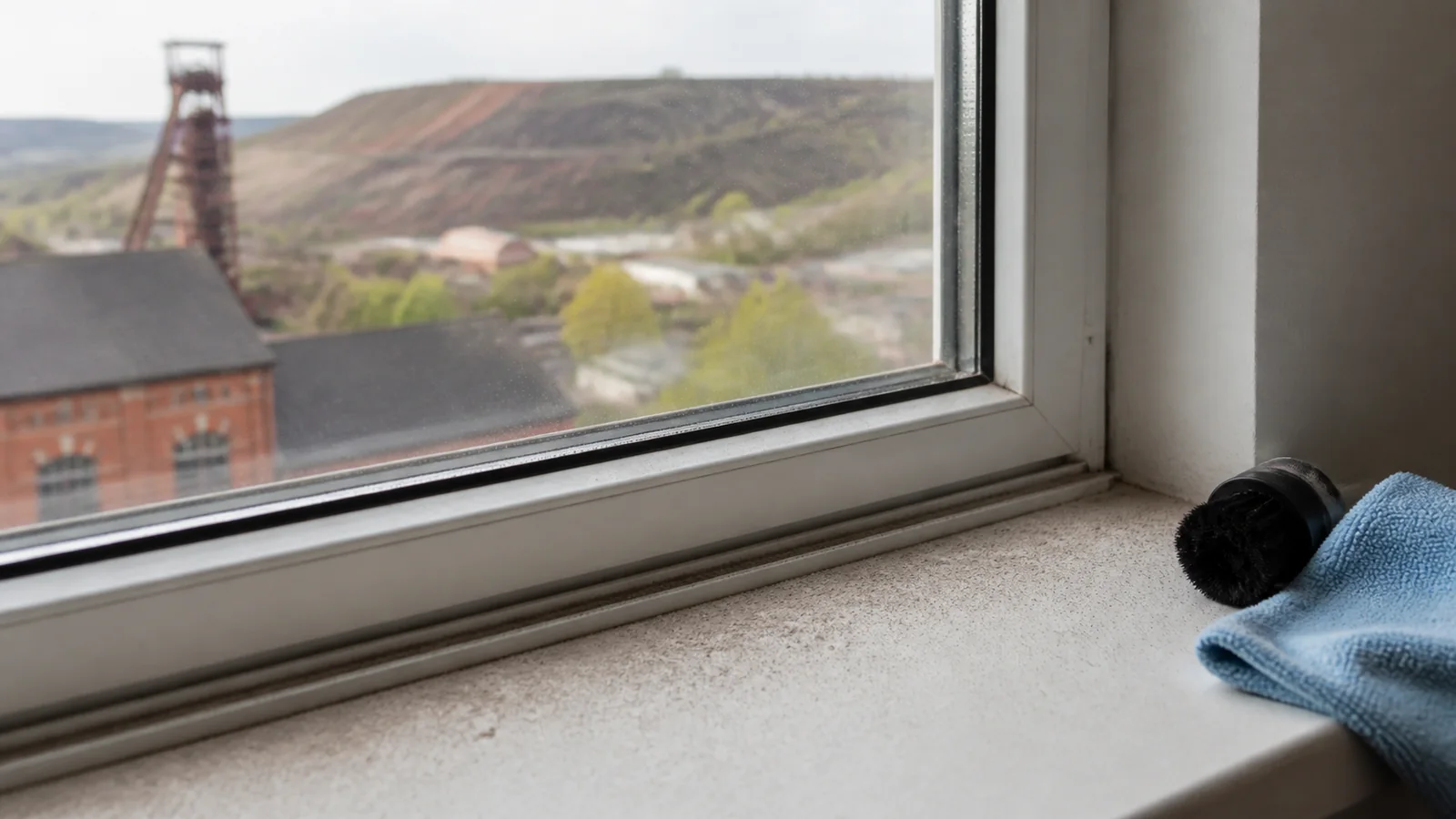
A thin grey-brown film can look distinctly reddish on a pale window sill. In the Minett, it is tempting to connect that colour with the region’s Red Rocks. The local history is real, but it does not tell us what a present-day deposit contains. Colour alone cannot identify its source.
Why is the Minett called the Land of the Red Rocks?
The name comes from the ground beneath the region. Luxembourg’s official national portal explains that the Minett takes its name from the bright red iron ore that drove its industrial development. The Geological Survey describes minette as an oolitic ironstone formed during the Middle Jurassic.
That heritage remains visible around Esch-sur-Alzette, Differdange, Dudelange and the former mining areas. Mining itself belongs to the past: Luxembourg’s last iron ore mine closed in 1981. This is a useful historical boundary, but it still does not identify the material found on a window sill today.
What the colour of a deposit cannot tell you
The Minett takes its name from the reddish iron ore that shaped its history. That does not make it possible to identify the composition of a present-day deposit by sight alone. In Luxembourg, airborne particles may come from road traffic, heating, industry, construction work or natural erosion, among other sources. Without analysing a sample, it is therefore safer to describe a grey, brown or reddish deposit rather than call it “iron dust”.
Indoor dust is variable too. Some particles are generated inside the home; others enter through openings or arrive on shoes and clothing. The French health agency ANSES reports that outdoor particles can enter buildings, settle on surfaces and later be resuspended. A nearby road or building site may affect how quickly dust returns, but it cannot explain the colour of a particular deposit on its own.
Why dust collects around windows
A sill is a horizontal surface beside an opening. It receives particles settling inside the room as well as particles carried in during air exchange. Tracks, seals and corners also trap small debris. Against white paint or pale PVC, even a very thin film is easy to see.
This is not a reason to keep windows closed. Our guide to ventilating your home explains how to renew the air without leaving rooms cold for long periods. The practical addition is simply to check the areas around the window and clean them when a deposit becomes visible.
How to clean glass, frames and sills safely
Ordinary glass, coated glass, PVC, painted timber and natural stone do not all need the same care. Before cleaning, check the manufacturer’s instructions for coated or self-cleaning glass, frames and sills. Work from a stable position and do not lean out of the window.
- Lift loose particles first. Use a clean brush attachment on the sill and tracks. Do not rub gritty dirt across dry glass.
- Start with a mild solution. For ordinary glass, warm water with a small amount of mild, non-abrasive detergent and a clean cloth or squeegee will usually be enough. Rinse if necessary and dry the edges.
- Match the product to the sill. Test it on an inconspicuous area first. Use a pH-neutral cleaner on natural stone: vinegar, lemon and other acids can dull or etch calcareous stone.
- Follow the label. Never mix cleaning products and rinse when the instructions require it.
Avoid cleaning glass while it is hot in direct sunlight, as the liquid can dry before you have finished. If you are working through more of the home at the same time, our room-by-room spring-cleaning guide offers a manageable order rather than an all-day list.
When should you clean again?
There is no universal schedule. Clean when the deposit becomes visible and adjust the timing according to traffic, nearby building work, pollen, weather and how often the windows are opened. A quick look at the sill and tracks is usually more useful than a fixed date in the calendar.
The aim is not to stop dust returning altogether. A sill facing a busy road may need attention sooner than one overlooking a quiet courtyard. Whatever its visible colour, use the same cautious method and adapt it to the surface in front of you.
Want to organise regular cleaning for your home?
Explore our residential cleaning service. The tasks to be carried out are agreed with you in the quote after discussing your home and priorities.
Request a visitSources
- Official Luxembourg portal — The Minett and the Red Rocks.
- Geological Survey of Luxembourg — geology and Minette ironstone.
- Official Luxembourg portal — the last iron ore mines closed in 1981 (PDF).
- Luxembourg Environment Administration — particulate matter and its sources.
- ANSES — transfer of outdoor air pollution into buildings.
- Guardian Glass — glass-cleaning guidance (PDF).
- Natural Stone Institute — caring for natural stone.