


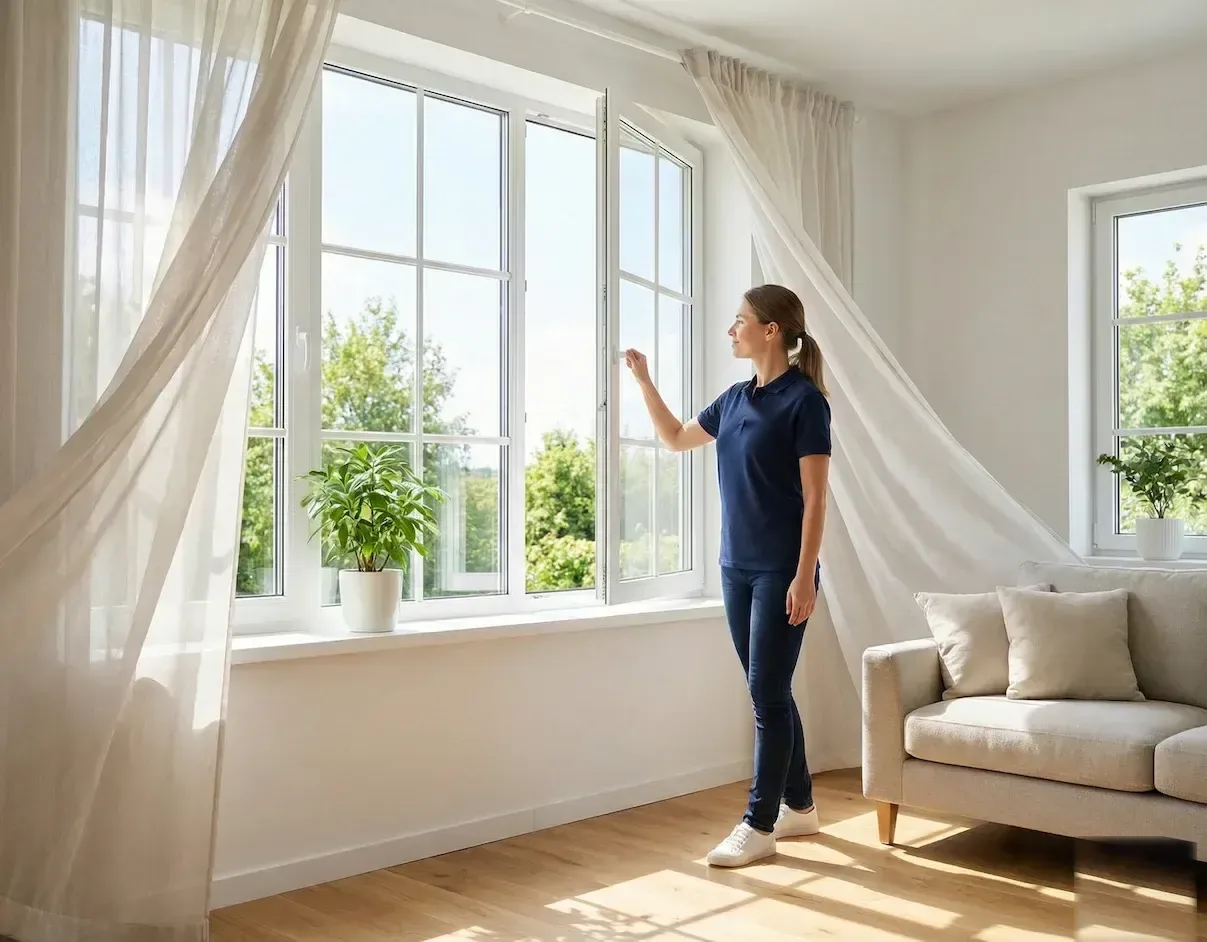
Ventilating your home does not mean leaving a window slightly open for hours. In most rooms, the simplest approach is to open the windows fully for a few minutes, then close them again. This quickly replaces stale indoor air without unnecessarily cooling down the walls and furniture.
As a general starting point, Luxembourg's Health Portal recommends airing every room at least twice a day. Each time, 5 to 10 minutes with the windows wide open is enough in many situations. You can then adapt this depending on the room: a bedroom after a night's sleep, a bathroom after a shower or a kitchen after cooking all benefit from more immediate air renewal. In a home with windows on opposite sides, cross-ventilation can replace the air in just a few minutes.
The aim is not to time every window opening, but to develop good habits and know when extra ventilation is useful.
Airing and ventilation do not have exactly the same role
Ventilation provides continuous air renewal through vents, ducts, a mechanical ventilation system or another system built into the home. Airing is the occasional act of opening windows to replace a large amount of indoor air quickly.
The two complement each other. A mechanical ventilation system should not be switched off simply because the windows are open, and air inlets or extraction vents should not be blocked to keep warmth inside. If a vent is dusty, you can clean the accessible part; a fault within the ventilation system itself, however, requires technical maintenance.
This is particularly important in newer or renovated homes. Modern windows are often much more airtight than older frames, so air no longer enters naturally through the small gaps that used to exist. Proper use of the ventilation system and regular window airing therefore become more important.
The simplest method: open windows fully rather than leaving them tilted
For everyday indoor air renewal, a useful routine is:
- open the windows fully at least twice a day, for 5 to 10 minutes each time;
- if possible, create cross-ventilation by opening windows on different sides of the home;
- air the room again after activities that generate a lot of moisture or pollutants;
- then close the windows rather than leaving them tilted for hours.
In a home where air can flow from one side to the other, particularly when there is some wind, 2 to 5 minutes may already provide substantial air renewal. With just one small window, little wind or a large room, it may take longer.
A tilted window can be useful occasionally, but it is not an efficient way to ventilate for long periods in winter. Air exchange is slower and surfaces around the window can become very cold. A short period with the window fully open is generally more effective.
When should you air each room?
The bedroom: especially after the night
During the night, people spend several hours breathing in a room that is often closed. Moisture and CO₂ gradually build up. In the morning, open the window fully for a few minutes. Doing it before making the bed can also make it easier to turn airing into part of your morning routine.
If several people sleep in the room, the bedroom is small or condensation regularly appears on the windows, airing more than twice a day may be useful.
The bathroom: immediately after a shower
Humidity rises very quickly in a bathroom. The best time to deal with it is straight after a shower or bath. Use the extractor fan if there is one, and open the window if the room has one.
While the room is drying, it is usually better to keep the door closed so that humid air does not spread into bedrooms and hallways. Wiping away larger amounts of water from shower screens or tiles can also help the room dry more quickly.
The kitchen: during and after cooking
Boiling water, cooking pasta, making soup or simmering food can release a considerable amount of steam. Use the cooker hood when appropriate and air the kitchen after cooking, particularly if the windows begin to mist up.
The living room: depending on how it is used
For a normally occupied living room, the basic rule of airing at least twice a day is often a good starting point. It is also useful after having several guests over, after the room has remained closed for a long period, after burning candles or incense, or whenever odours linger.
The room where laundry is drying
Drying laundry indoors releases a significant amount of moisture into the air. If you have no alternative, try not to allow that moisture to spread throughout the entire home. Air the room containing the drying rack and keep an eye out for condensation on windows or cold walls.
How can you ventilate in winter without cooling the whole house?
Short, intensive airing is particularly useful in winter. Opening the windows fully for 5 to 10 minutes replaces the indoor air quickly, while the walls, floors and furniture do not have enough time to lose all the heat they have stored.
If your heating system allows it, temporarily turn down or switch off the radiator directly below the window while airing, then turn it back on once the window is closed.
You do not have to wait for a dry day. Even when it is raining or foggy, cold outdoor air can contain less water overall than warm indoor air. Once this colder air enters the home and warms up, it can therefore help reduce indoor humidity.
In summer, distinguish between air renewal and cooling
Opening the windows for a few minutes is still useful for renewing indoor air. But if the aim is also to cool the home, the strategy changes: make greater use of periods when the outdoor air is cooler than the indoor air.
In Luxembourg, this often means opening windows for longer during the night and early morning, then closing them and shading the windows once outdoor temperatures rise. In a multi-storey house, opening windows downstairs and upstairs can help warm air escape.
There are, however, situations in which it is better not to open the windows, even when you would normally want to renew the air. The wildfire in the High Fens in Belgium provided a very real example in August 2026. The fire started on 14 August 2026 at around 1 p.m. in Baelen and quickly spread across several thousand hectares. Smoke travelled far beyond the area directly affected by the fire.
On 17 August 2026, Luxembourg authorities recorded an increase in fine particulate matter linked to the smoke, with the alert threshold for PM10 exceeded. Smoke and a smell of burning were also noticeable in several parts of the Grand Duchy.
In an exceptional situation like this, the usual advice about airing your home is temporarily reversed. If there is smoke or a strong smell of burning outside, it is better to keep doors and windows closed and limit the amount of outdoor air entering the home, then resume airing once conditions improve.
Information on air quality in Luxembourg can be used to check current conditions during an unusual pollution episode.
Take extra care with basements and cellars on hot days
A basement does not behave like a living room. Its walls often remain cool even in summer. Letting warm, humid outdoor air into the basement during the hottest part of the day can therefore encourage condensation on these cold surfaces.
During spring and summer, it is better to air a cellar or basement during the coolest periods, often at night or early in the morning. If persistent dampness, wet walls or a musty smell remain despite this, window airing alone may not be enough to address the underlying cause.
A hygrometer can help you understand what is happening
A small hygrometer allows you to monitor the relative humidity in a room. It is particularly useful for observing patterns: humidity rising after a shower and then falling again, a bedroom remaining humid for several hours, or a basement that never really dries out.
Luxembourg's Ministry of Housing states that indoor relative humidity should not remain constantly above around 65 to 70%. A high reading for a few minutes after a shower therefore does not mean the same thing as elevated humidity that persists every day.
If condensation repeatedly appears in the same place or black marks appear on the walls, it is worth looking beyond your airing habits. Insufficient ventilation, water ingress, a leak, a cold surface or a thermal bridge may also be involved.
Airing during and after cleaning
Cleaning can stir dust back into the air, while some household cleaning products can release substances indoors. It is therefore useful to open the windows after vacuuming or using cleaning products, particularly during a thorough spring clean.
There is no need to turn everyday cleaning into a complicated procedure. In most ordinary situations, a few minutes of thorough airing, combined with sensible use of cleaning products and following their instructions, is enough.
Mistakes that make airing less effective
A few habits are particularly common:
- leaving a window tilted for hours during winter;
- blocking a ventilation grille because cold air is coming through it;
- airing only rarely, for example once a week;
- leaving the bathroom door open after a shower and allowing humidity to spread throughout the home;
- drying large amounts of laundry in a closed room without renewing the air;
- assuming that an air freshener or room fragrance can replace fresh air.
Airing works best when it is short, regular and done at the right time.
When airing is no longer enough
Opening a window can remove some of the moisture and pollutants present in indoor air, but it cannot repair a problem with the building itself.
If mould keeps returning after cleaning, a wall remains damp, a musty smell persists or the ventilation system appears to have stopped working properly, the underlying cause needs to be identified. Simply leaving the windows open for longer may hide the problem without solving it.
In summary
For most homes, remember one simple rule: open the windows fully at least twice a day, for 5 to 10 minutes, and do it again when a lot of moisture is produced — after a shower, substantial cooking or drying laundry indoors. Cross-ventilation can work even faster.
In winter, favour short, intensive airing rather than leaving a window slightly open for a long time. In summer, air the home more when it is cooler outside, paying particular attention to basements and cellars. And if outdoor air is unusually affected by smoke or particles, as happened during the High Fens wildfire in August 2026, wait until air quality improves before returning to your normal airing routine.
Need Help with Regular Home Cleaning?
Fast Clean can review the rooms and surfaces included in your cleaning request and set out the proposed scope in a quote.
Request a Quote