

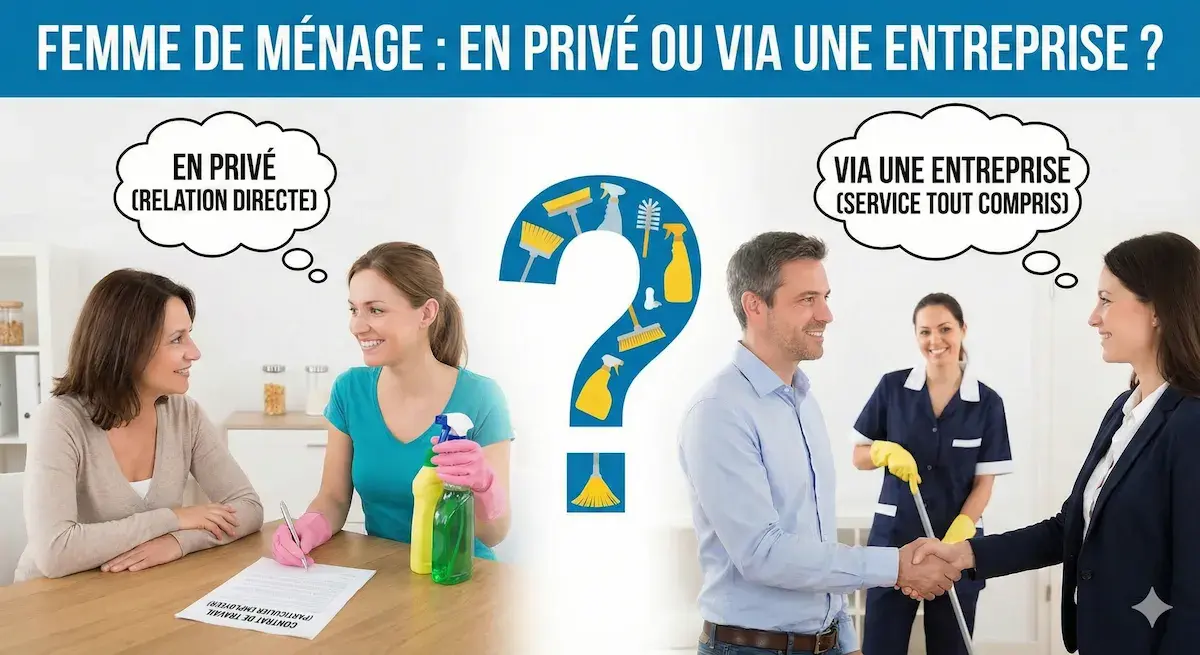
You would like to delegate the cleaning of your home in Luxembourg, but you are unsure whether to employ someone directly or use a cleaning company.
Both options can meet your needs. The difference is not limited to price: it also concerns who chooses the cleaner, how much time you spend on organisation, how absences are handled and which responsibilities you are prepared to take on.
Residential cleaning is at the heart of Fast Clean’s work. Using a company like ours allows you to delegate the cleaning without becoming an employer. Direct employment nevertheless has genuine advantages, particularly for people who want to choose their own employee and organise the work directly.
Here is what each option involves in practice.
1. Choosing a person or choosing a service
With direct employment, you recruit the person who will work in your home. You discuss your expectations, agree on working hours and decide together which tasks will be carried out.
This direct relationship can be a real advantage. If you already know someone whose work suits you, or if you want to take an active role in recruitment, this option is worth considering. You choose your employee and build an ongoing working relationship with them.
With a company, you first choose a service provider and the cleaning service it offers. You explain what you need and then check what the company offers in response. The company is your contractual point of contact and manages its own employment relationship with its staff.
In either case, the quality of the cleaning cannot be inferred from the worker’s status alone. Your expectations, the time available and the agreed tasks also matter. A directly employed cleaner can provide excellent work; using a company does not remove the need to explain what you expect.
The first question is therefore straightforward: do you want to choose and supervise a person yourself, or entrust the cleaning to a service provider?
2. How much time do you want to spend on organisation?
Employing a household cleaner directly does not mean that every formality will be complicated. In Luxembourg, the CCSS simplified procedure notably makes registration and contribution calculations easier.
You nevertheless remain the employer. The employment contract, payment of salary, leave and changes to the employment relationship are your responsibility. Guichet.lu outlines the main obligations of a private household employer.
This arrangement may suit you very well if you have time to manage it and want to retain direct control over the working relationship.
The benefit of a company such as Fast Clean is different: you purchase a service without having to handle the paperwork involved in employing the cleaner. You do not draw up the cleaner’s employment contract and you do not manage their social security declarations.
This does not mean that no communication is required. You still need to explain your priorities, provide access to the home and report a particular need or difficulty. These discussions concern the cleaning to be carried out, however, rather than your role as an employer.
For a household that wants to delegate cleaning without adding an employment relationship to manage, this distinction may matter just as much as the price.
3. What happens during absences or when a problem arises?
A cleaner may take leave or fall ill, whether they are employed directly or by a company.
With direct employment, you organise leave with your employee and plan for periods without a visit. If you need the cleaning to continue during their absence, it is up to you to find a solution.
It is also important to distinguish the organisation of the cleaning from the cost of sickness absence. Under the private household scheme, pay advanced by the employer during illness may be reimbursed by the CNS under the applicable procedure. An absence should therefore not be presented as a cost that the private employer necessarily bears in full. The CCSS explains how this works.
With a company, you have a service provider to contact about continuity of service. This is a practical benefit of the arrangement, but it does not guarantee that a replacement will always be available or available immediately. Before signing, ask what is actually provided for in the event of an absence or postponement.
The same distinction applies when a task has been missed or the result does not meet your expectations. With direct employment, you discuss it with your employee and adjust the organisation together. With a company, you can contact the service provider. The way a complaint or possible return visit is handled should still be checked rather than assumed.
4. How can you compare prices fairly?
A net hourly wage and the price invoiced by a cleaning company do not represent the same thing.
With direct employment, the salary paid to the cleaner is only part of the expense. You must also consider the amounts due to the CCSS, any products and equipment that remain your responsibility, and the effect of paid periods without a cleaning visit.
The cost should not be artificially inflated, however. Do not add net pay, gross pay and social contributions as three separate expenses. If paid leave is already included in your annual calculation, do not add it a second time. You should also take account of reimbursements actually received.
For a company, start with the price including VAT and check what it covers. Products, equipment or travel may be included or charged separately; only the actual offer will tell you. The professional must provide written price information or explain how the price will be calculated when it cannot be fixed in advance. These rules are set out on the Guichet.lu page about price information for services.
For a useful comparison, use the same tasks, the same number of hours and the same period. First determining a cleaning frequency suited to your home helps you avoid comparing two proposals that do not address the same need.
Direct employment may be financially attractive in some situations. A company may in turn be attractive because it takes responsibility for managing its staff. The choice depends on the full expense as well as on what you want to manage yourself.
The tax benefit is not limited to direct employment
Subject to conditions, household cleaning expenses may qualify for a tax allowance both when you employ someone directly and when you use a company.
For 2026, the ceiling is €450 per month and €5,400 per year, limited to the expenses actually incurred. This reduces taxable income; it is not a reimbursement of your invoices.
The scheme applies to resident taxpayers and non-residents treated as residents for tax purposes who meet the relevant conditions. The ceiling is shared across the categories of eligible expenses, including certain childcare and assistance costs. The Administration des contributions directes provides the detailed rules.
5. Have your needs changed? Easily adjust the frequency with Fast Clean
Your cleaning needs may change. A visit every week may have suited you until now, but you may prefer a visit every two weeks from now on.
At Fast Clean, this change of frequency is easy to make. Tell us how often you would like us to visit, and we adapt the service. You do not have to manage the consequences of this change for the employment contract of the person carrying out the cleaning; that responsibility remains with the company.
With direct employment, reducing the frequency may also reduce the employee’s working hours and pay. The change then affects the employment relationship, not just the cleaning calendar. If both parties agree, the change can be formalised in writing. The ITM explains the arrangements for such an agreement.
Without that agreement, a unilateral, detrimental change affecting an essential term of the employment contract requires a specific procedure. It cannot be treated as a simple scheduling change. Source: ITM.
This does not mean that direct employment necessarily leads to tension. An adjustment may suit both parties perfectly well. Fast Clean’s flexibility nevertheless allows you to change how often your home is cleaned without having to manage changes to an employment contract yourself.
6. What Fast Clean can offer you
Using Fast Clean means choosing a cleaning company for your home in Luxembourg without becoming the employer of the person who carries out the work.
The practical benefit is clear: you entrust the cleaning to a service provider and leave it to manage its staff. Your attention stays on the tasks you expect and the service agreed, rather than on the obligations involved in employing someone.
This option may suit you if you want to delegate the cleaning while limiting the administrative work you handle personally.
| Your priority | What to keep in mind |
|---|---|
| Choosing your own employee and organising their work directly | Direct employment may suit this preference well. |
| Delegating the cleaning without becoming an employer | A company such as Fast Clean matches this preference. |
| Keeping control of your budget | Compare the full cost for the same tasks and the same frequency. |
| Planning for absences and changes | Examine the possible arrangements and the conditions provided under each option. |
If you have already found someone you trust and are comfortable with the responsibilities of being an employer, direct employment can be a good choice. There is no reason to present it as a poor solution in principle.
If you would rather entrust the cleaning to a company, you can explore our residential cleaning service. Tell us about your home, the tasks you want completed and the frequency you are considering, then request a quote so that you can compare a concrete proposal with your needs.
Legal and tax references checked as of 6 September 2026.